The short version
Bat removal in Chula Vista, CA typically runs $400–$1,500 for exclusion with one-way cones, with sealing and guano cleanup adding more. For a home in Chula Vista, CA, the factors that move the price are the roost size, the entry points, and the cleanup.
- Bats enter through gaps as small as 3/8 inch.
- Exclusion is timed outside maternity season.
- Guano cleanup is a protective-gear health job.
- Seal every gap after they leave.
For anyone in Chula Vista, CA seeing bats at dusk, finding guano, or dealing with a bat indoors. In Chula Vista, if a bat was in a room where someone was sleeping, contact your health department first.
What to look for
In Chula Vista, bats are in their maternity season from late spring through summer (roughly May through August), when females raise pups in roosts, and they enter through gaps as small as 3/8 inch. In Chula Vista, the real problem isn't the bat you see at dusk; it's the roost it's returning to and the gap it found. Bats don't wander into your Chula Vista, CA attic by accident — they're returning to a warm, dark roost, and they come back to the same one year after year.
- 1Bats streaming out of the roofline or eaves at dusk.
- 2In Chula Vista, squeaking and chirping at dusk and dawn from an attic or wall.
- 3Guano — dark, crumbly droppings with shiny insect flecks — under a gap.
- 4A greasy stain around a roofline opening.
- 5In Chula Vista, a bat found indoors, especially in a room where someone was sleeping.
- 6An ammonia smell in the attic.
Why it’s worth acting soon
- Rabies exposure (CDC) — a possible bite risk.
- Histoplasma fungus from inhaled guano (CDC).
- Maternity-season exclusion can strand flightless pups.
- Guano soaks insulation and causes a lingering odor.
🧮
Estimate bat removal cost in Chula Vista
Adjust for your situation to see a ballpark range.
Estimated range
A rough guide only. Sealing and attic cleanup can cost more.
Treatment options and typical costs
Inspection and roost mapping
$150–$300
Confirm the roost and every entry gap on the Chula Vista property, and plan the work around the spring and late-summer exclusion windows in Chula Vista. In California: CDFW does not publish a statewide blackout; follow maternity timing of the local colony.
- Time
- 45–90 minutes
- Best for
- Any sighting or dusk activity.
Exclusion with one-way cones
$400–$1,500
Cones let the Chula Vista colony leave but not return, installed outside the May to mid-August maternity period.
- Time
- A few days to a week
- Best for
- A roost in an attic or wall.
Sealing and repair
$300–$1,000+
Seal every gap larger than 3/8 inch once the Chula Vista roost is empty; a mid-August to mid-October closure suits the Chula Vista area.
- Time
- Half day to a full day
- Best for
- Preventing re-entry.
Guano cleanup and decontamination
$500–$2,500+
Remove guano and soiled insulation with protective gear (CDC).
- Time
- Half day to a day
- Best for
- An attic with accumulated guano.
Prices are typical published ranges. Ask what’s included before you compare quotes.
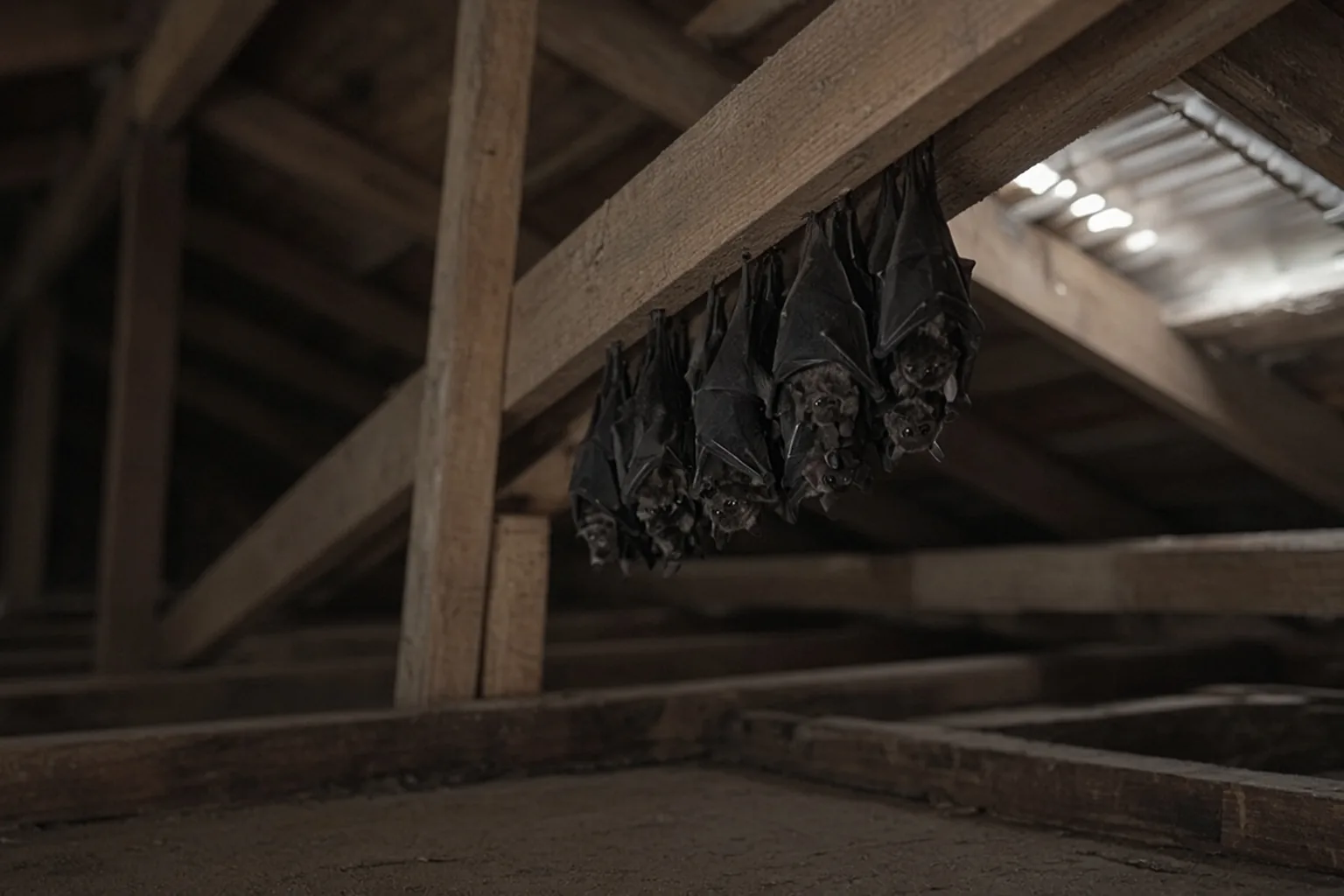 A cluster in the rafters means a roost. Leave them be until pups can fly.
What bat removal costs in Chula Vista, CA.
In Chula Vista, ask every provider the same questions: how many entry points, is guano cleanup included, is the work timed outside maternity season, and what does the re-service cover. In Chula Vista, a lower number that skips sealing isn't cheaper — it's job one of three. Pricing bat removal in Chula Vista, CA? Start with the published ranges, then ask what's included. In Chula Vista, exclusion with one-way cones runs roughly $400 to $1,500, sealing and repair from $300 up, and guano cleanup from $500 up (Fixr, published ranges).
Bats around Chula Vista.
The bats you'll meet around Chula Vista are usually big brown bats and little brown bats — nocturnal, insect-eating mammals that roost in warm, dark attics. In Chula Vista, they return to the same roost year after year, entering through gaps as small as 3/8 inch, and a dusk watch from the street is the easiest way to confirm the roost and count how many leave.
 Check the whole outside of the house. Bats need only a half-inch gap.
When bat season runs around Chula Vista.
Around Chula Vista, CA, bats are in their maternity season from late spring through summer (roughly May through August), when females raise pups in roosts. In Chula Vista, spring and summer are maternity season, when females raise pups — which is when exclusion is off-limits and most conflicts with homeowners start.
How they get into Chula Vista homes.
In Chula Vista, the greasy stain around an entry is the telltale sign of bats using it, and a dusk watch from the street will confirm where they come and go. Around Chula Vista, 10 inches of rain a year and 70% humidity mean roofline gaps open more from sun and age than rot. In Chula Vista, bats squeeze through gaps as small as 3/8 inch — in the roofline, the soffits, the gable vents, and behind the chimney.
The risks around Chula Vista, CA.
Guano carries Histoplasma fungus, a respiratory risk (CDC). In Chula Vista, both mean: don't handle it yourself, and never sweep the guano without protection. In Chula Vista, bats are a leading source of rabies exposure in the U.S., though most bats are not rabid (CDC) — a bat in a room where someone was sleeping is treated as a possible exposure.
Getting them out the right way around Chula Vista.
In Chula Vista, the humane method is exclusion — one-way cones that let bats leave but not return — installed outside maternity season. In Chula Vista, a professional times it so no pups are stranded, then seals every gap larger than 3/8 inch and cleans the guano with protective gear, so the attic is safe to use again.
The three jobs of bat control in Chula Vista.
- Get them out: one-way cones let the colony leave humanely. - Close the door: seal every gap larger than 3/8 inch. - Clean the roost: remove the guano and soiled insulation safely.
A quote in Chula Vista usually covers only the first job — ask which of the three it covers before you sign anything. - Every bat problem around Chula Vista is three jobs in order.
What bat control costs in Chula Vista.
In Chula Vista, published ranges put exclusion around $400 to $1,500, with sealing and guano cleanup adding more (Fixr). For a Chula Vista home, the four things that move the price are the roost size, the entry points, the guano cleanup, and the height and access of the roofline.
Working within the rules in Chula Vista.
In Chula Vista, bats are protected by federal and state law, so exclusion must avoid maternity season and use humane, one-way methods. In Chula Vista, check with California DFW for current rules, and have a licensed wildlife professional schedule the work for the legal window, usually late fall and winter, when the colony has already left the attic.
Ways to keep the cost down in Chula Vista, CA.
In Chula Vista, seal the gaps in fall and winter, after bats have left, and screen the vents yourself. In Chula Vista, a property that's already bat-proof needs less exclusion and a smaller quote. The cheapest bat job is the one you prevent.
What affects the price
- In Chula Vista, the size of the roost and how many entry points need sealing.
- Whether the attic has accumulated guano that needs cleanup.
- The height and accessibility of the roofline.
- Whether soiled insulation needs replacing.
- In Chula Vista, the timing — exclusion cannot be done while pups are in the roost.
- Whether follow-up monitoring is included.
📊
What matters most in a bat quote?
When to call for help
In Chula Vista, call a licensed professional when bats are roosting in the attic or walls, when you find guano, or when a bat is inside the living space — especially if someone was sleeping nearby. In Chula Vista, bats are protected, so exclusion must be timed outside the May–August window, and a professional will schedule the work for the correct legal window.
What you can do yourself
In Chula Vista, the timing and the law make bats a pro's job: exclusion can't be done while pups are in the roost without stranding them, and guano cleanup needs protective gear for the Histoplasma risk. In Chula Vista, sealing gaps in fall and winter and screening vents is the part you can safely do yourself, but the roost itself belongs with a licensed professional.
Bats in Chula Vista
47°F winter lows are mild enough that bats stay active through much of the year. In Chula Vista, bats are in their maternity season from late spring through summer (roughly May through August), when females raise pups in roosts, roosting in attics and walls through gaps as small as 3/8 inch — and because they're protected, exclusion belongs with a licensed professional, timed outside maternity season. In Chula Vista, 78°f summer highs make an attic the warm, sheltered roost a maternity colony wants, and 70% humidity and 10 inches of rain a year keep attic guano damp and slow to dry. In Chula Vista, the common attic species here are big brown bats and little brown bats.
Local research
Bats in Chula Vista, CA: what the public record shows
Before you compare quotes, it helps to know which bats actually live in California, when they are busiest around Chula Vista, and what the state figures look like. Everything below links to the agency or university page it came from.
Bat species recorded in California
- Little brown bat (Myotis lucifugus) — Historically the classic attic colony bat; >90% WNS decline; listed threatened or endangered in several states (e.g., WI threatened, PA and VA endangered).
- Yuma myotis (Myotis yumanensis) — Western building-roosting bat; likely source of the first WNS fungus detection in Oregon (2025).
When bats are busiest around Chula Vista
CDFW does not publish a statewide blackout; follow maternity timing of the local colony.
Rules that apply in California
For context, nationally
- 35% — Share of U.S. rabid animals that are bats. CDC
- All U.S. states except Hawaii — Rabid bats reported in. CDC
Sources: California Department of Fish and Wildlife; CDC; White-Nose Syndrome Killed Over 90% of Three North American Bat Species; White-nose syndrome causing fungus detected for the first time in Oregon. Figures are quoted as the source prints them. How we check our sources
Simple ways to keep bats away
- In Chula Vista, seal every gap larger than 3/8 inch in the roofline, soffits, and vents.
- Screen attic vents and chimney openings with fine mesh.
- In Chula Vista, check the roofline each spring before bats return, and again in fall.
- In Chula Vista, keep attic and gable vents covered so bats cannot find a roost.
- Seal gaps in late fall or winter, after bats have left.
- Never seal during the summer pup-rearing months.
 Once the bats are out, every gap gets sealed with lasting materials.
Did you know?
A single little brown bat can eat up to 1,000 mosquito-sized insects in an hour.
Bats are the only mammals capable of true sustained flight.
In Chula Vista, most bats are not rabid — less than one percent carry the virus, but a grounded or day-active bat is a warning sign.
Questions people ask
How do I know if bats are roosting in my Chula Vista, CA home?
In Chula Vista, watch the roofline at dusk — bats leaving at the same time each evening is the clearest sign, along with guano and a greasy stain around the entry.
Is it legal to get rid of bats around Chula Vista, CA?
In Chula Vista, bats are protected, so exclusion has to be humane and carefully timed outside the May–August window. In Chula Vista, killing or trapping them is illegal; a licensed professional does it by the book.
What does a bat exclusion around Chula Vista, CA cost?
In Chula Vista, published ranges put exclusion around $400 to $1,500 (Fixr), with sealing and guano cleanup added on top. The roost size and cleanup are what move the number.
Do I need a rabies shot after finding a bat around Chula Vista, CA?
In Chula Vista, that's a question for your doctor or health department — if the bat was in a room where someone was sleeping, treat it as a possible exposure and call them rather than guessing.
Can a bat get back into my Chula Vista, CA home after exclusion?
Only if a gap larger than 3/8 inch is left open. In Chula Vista, sealing every entry is what makes the exclusion permanent, so confirm the scope in writing before the work starts.
How many bats live in a Chula Vista, CA attic colony?
In Chula Vista, it varies from just a few to a maternity colony of dozens or more. In Chula Vista, a professional sizes it with a dusk count, which is also what determines the cleanup and the final price.
What should I do if a bat is in my Chula Vista, CA home right now?
In Chula Vista, close the door to the room, keep people and pets out, and call for help. In Chula Vista, if it was in a room where someone was sleeping, treat it as a possible rabies exposure and contact your health department.
Nearby cities
Related guides
Sources (6)
The facts in this article come from the public sources listed above. Every home is different, so ask the company you talk to about pricing and what’s included. Published by Bat Exterminator · Updated October 13, 2026 · How we write these guides